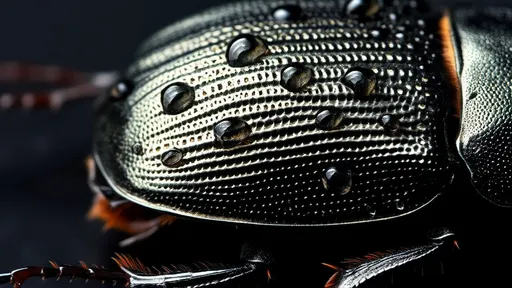
In the arid landscapes where water is a precious commodity, nature has evolved ingenious solutions to harvest moisture from the air. Among these, the Namib Desert beetle stands out as a master of water collection. Its unique shell, adorned with a pattern of hydrophilic (water-attracting) and hydrophobic (water-repelling) regions, allows it to condense fog into drinkable water droplets. This remarkable adaptation has inspired scientists to develop biomimetic materials capable of harvesting water in even the driest environments.
The beetle's shell is a marvel of natural engineering. The hydrophilic bumps on its back attract water molecules from the air, while the surrounding hydrophobic areas prevent the droplets from spreading, allowing them to grow until they roll down into the beetle's mouth. This process, known as fog basking, enables the beetle to survive in one of the harshest climates on Earth. Researchers have long sought to replicate this mechanism, but creating synthetic surfaces that mimic the beetle's efficiency has proven challenging.
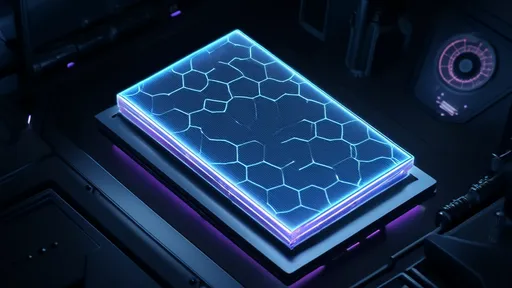
Recent advancements in material science have brought us closer to achieving this goal. By studying the precise arrangement of hydrophilic and hydrophobic regions on the beetle's shell, scientists have developed surfaces with patterned wettability. These surfaces can selectively capture and direct water droplets, mimicking the beetle's natural water-harvesting ability. The key lies in the precise control of surface chemistry and topography at the micro- and nanoscale.
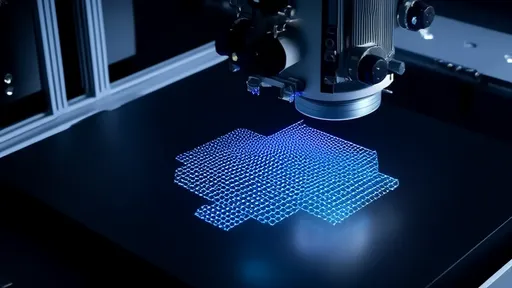
One promising approach involves using laser etching or chemical vapor deposition to create alternating hydrophilic and hydrophobic zones on a surface. These patterns can be tailored to optimize water collection under different environmental conditions. For instance, in high-humidity areas, a denser array of hydrophilic spots may be more effective, while in drier regions, a more spaced-out pattern could work better. The ability to customize these surfaces opens up new possibilities for water harvesting in diverse climates.
Beyond simple water collection, researchers are exploring how these patterned surfaces can be adapted for use throughout the day-night cycle. During cooler nights, when humidity is higher, the surfaces can efficiently capture moisture from the air. As temperatures rise during the day, the collected water can be stored or directed for immediate use. This diurnal adaptation mirrors the beetle's natural behavior, which times its fog-basking activities to coincide with optimal environmental conditions.
The potential applications of this technology extend far beyond providing drinking water in arid regions. In agriculture, such surfaces could be used to collect dew for irrigation, reducing reliance on traditional water sources. In industrial settings, they could help recover water from exhaust gases or improve the efficiency of condensation-based processes. Even in space exploration, where every drop of water is precious, these biomimetic materials could play a crucial role in life support systems.
However, challenges remain in scaling up this technology for practical use. While laboratory prototypes have demonstrated promising results, creating large-scale, durable surfaces that maintain their water-harvesting properties over time is not trivial. Environmental factors like dust accumulation, UV degradation, and temperature fluctuations can all affect performance. Researchers are now focusing on developing robust materials that can withstand real-world conditions while maintaining their carefully engineered surface properties.
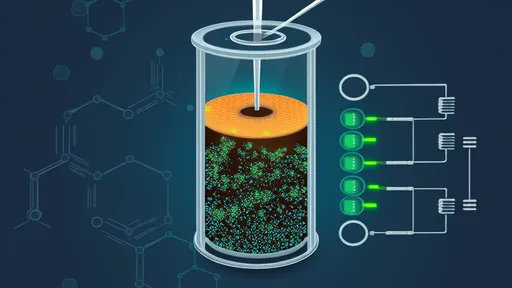
Another exciting direction is the integration of these patterned surfaces with other water-harvesting technologies. For example, combining them with traditional fog nets or solar stills could create hybrid systems that maximize water collection efficiency. Some researchers are even exploring how to incorporate responsive materials that can change their wettability in response to environmental cues, creating "smart" surfaces that adapt to changing conditions just like living organisms.
The study of beetle-inspired water harvesting also offers insights into fundamental questions about surface science and fluid dynamics. Understanding how water droplets nucleate, grow, and move across these patterned surfaces could lead to advances in fields ranging from microfluidics to thermal management. The humble desert beetle, through millions of years of evolution, has provided us with a masterclass in sustainable water collection that we are only beginning to fully appreciate and replicate.
As climate change exacerbates water scarcity in many parts of the world, the need for innovative solutions becomes ever more pressing. Biomimetic approaches like the beetle-inspired water-harvesting surfaces offer a promising path forward, combining nature's wisdom with human ingenuity. While there is still much work to be done, these technologies represent a hopeful vision of how we might sustainably meet our water needs in an increasingly arid future.

By /Jul 28, 2025

By /Jul 28, 2025

By /Jul 28, 2025

By /Jul 28, 2025

By /Jul 28, 2025
By /Jul 28, 2025

By /Jul 28, 2025
By /Jul 28, 2025

By /Jul 28, 2025
By /Jul 28, 2025

By /Jul 28, 2025
By /Jul 28, 2025
By /Jul 28, 2025

By /Jul 28, 2025

By /Jul 28, 2025
By /Jul 28, 2025

By /Jul 28, 2025

By /Jul 28, 2025

By /Jul 28, 2025
By /Jul 28, 2025
